
How to Read Honey Labels and Never Get Fooled Again (Quebec Guide)
Share
How to Read Honey Labels and Never Get Fooled Again
You pick up a jar of honey at the grocery store. The label says "pure," "natural," and "golden." It looks premium. It costs three times as much as the store brand. You assume you are buying something good.
You might be right. But you might also be buying heat-treated honey diluted with corn syrup, imported from countries with minimal quality controls, relabelled and sold in a nice jar.
Honey fraud is a documented global problem. Research published in the Journal of Agricultural and Food Chemistry developed rapid detection methods specifically because sugar syrup adulteration in honey - with corn syrup, rice syrup, and inverted syrup - is so widespread it required dedicated scientific tools to identify. In Canada, the Canadian Food Inspection Agency explicitly states that adding foreign sugars like corn, rice or cane syrup to honey is illegal adulteration under the Safe Food for Canadians Act - and they conduct regular surveillance to find it.
The label is your only tool as a consumer. This guide breaks down every major term you will see on a honey jar so you can shop with confidence every single time.
The Most Important Thing: Read the Ingredients List First
Before you look at anything else on a honey label, flip the jar over and find the ingredients list. There should be exactly one ingredient: honey.
If you see anything else - glucose, fructose syrup, corn syrup, sugar, citric acid, or any additive - put it back. That is not honey. That is a honey-flavoured product, and no amount of premium-looking front-label design changes that fact.
In Canada, the legal standard of identity for honey under the Canadian Standards of Identity, Volume 5 defines honey as a product derived exclusively from bees and nectar - nothing added, nothing removed beyond basic straining. Any product that does not meet this definition cannot legally be called honey in Canada.
Also check the country of origin. Canadian law requires honey labels to clearly state where the honey was produced. A label that says "Product of Canada" means the honey was harvested in Canada. A label that says "Product of Canada and other countries" or "blend of honeys" means some or all of it may be imported from places with different standards. This is not necessarily bad, but it matters for transparency.
Quick rule: If the ingredients list has anything besides "honey," stop reading and move on. Everything else on the label is irrelevant if the product is not pure honey.
1. Raw Honey - The Most Important Label Claim
"Raw" is the single most meaningful term on a honey label. It means the honey has never been pasteurized (heated to high temperatures) and has been minimally filtered - typically just strained through mesh to remove wax and debris from the hive.
Why does this matter so much? Because honey is not just sugar. Raw honey contains a complex profile of active compounds - enzymes like diastase and glucose oxidase, phenolic antioxidants, flavonoids, pollen, propolis particles, and natural antimicrobial compounds. These are what give real honey its health properties.
The problem is that most of these compounds are heat-sensitive. A peer-reviewed study published in Foods journal confirmed that pasteurization at commercial temperatures effectively eliminated microbial activity in honey but also compromised its physicochemical quality and antioxidant activity - meaning the process that extends shelf life simultaneously destroys the properties that make honey valuable beyond being a sweetener.
The enzymes in particular are the casualties of pasteurization. Glucose oxidase - the enzyme responsible for producing hydrogen peroxide, which is honey's primary antimicrobial mechanism - is heat-sensitive and degrades rapidly above 45 degrees Celsius. Commercial pasteurization typically applies temperatures of 70 to 80 degrees Celsius. By the time honey reaches the shelf in the standard golden-clear liquid form most people recognize, much of its enzymatic activity is already gone.
How to Confirm a Honey is Truly Raw
- Raw honey will often be cloudy, thick, or partially crystallized - this is normal and is actually a sign of quality
- The label should say "raw" or "unpasteurized" explicitly
- The colour is often less uniform - different floral sources produce different hues
- If a honey is crystal-clear and perfectly smooth liquid at room temperature, it has almost certainly been pasteurized and finely filtered
- Buy from a local beekeeper when possible - small producers like us have no commercial incentive to pasteurize, since we sell directly and do not need extended shelf stability for retail distribution
2. Unpasteurized Honey
"Unpasteurized" and "raw" are closely related but not always identical terms. Unpasteurized simply means the honey has not been heat-treated. Raw typically implies both unpasteurized and minimally filtered. In practice, when you see either term on a Canadian honey label, it means the honey has not been subjected to commercial heat processing.
Some producers use "unpasteurized" specifically because it is the more technically precise term under Canadian labelling guidelines. Both are positive signals - either tells you the enzymes and heat-sensitive antioxidants are intact.
The opposite is pasteurized honey, which is the default for most large commercial brands. Pasteurization is done for cosmetic and logistical reasons - it produces the clear, smooth, liquid product that pours easily and looks appealing on store shelves, and it prevents fermentation during the long supply chains of mass distribution. The trade-off is the bioactive properties discussed above.
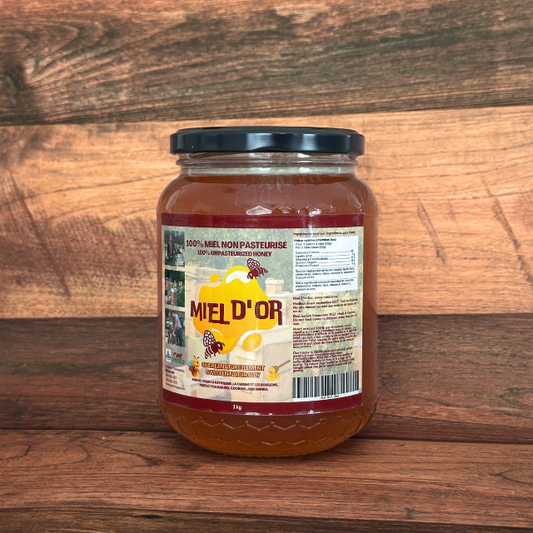
Our Quebec raw honey is never heated above the natural temperature of the hive, preserving the full enzyme and antioxidant profile that makes raw honey genuinely different from the processed product.
3. Pure Honey
"Pure honey" means the jar contains only honey with no added ingredients. It is a compositional claim - not a quality claim. Pure honey can still be pasteurized, ultra-filtered, and of low nutritional value. It can be sourced from anywhere in the world and blended from multiple countries.
Do not mistake "pure" for "raw" or "unprocessed." They are completely different claims. A jar labelled "100% pure honey" tells you nothing about whether it was heated, where it came from, or what its enzyme activity looks like. It only tells you that corn syrup was not added - which should be the minimum standard anyway, not a marketing highlight.
In Canada, the CFIA has specific guidance on the use of the term "pure" in honey labelling. It is a factual compositional claim, not a quality designation. Do not let attractive packaging around the word "pure" substitute for reading the full label.
4. Organic Honey
Certified organic honey is one of the most difficult food certifications to legitimately obtain, and one of the most frequently misrepresented.
For honey to be genuinely certified organic, the bees must forage exclusively in areas free from synthetic pesticides, herbicides, and GMO crops - within a radius of approximately 3 to 5 kilometres from the hive, since that is the typical foraging range of a honeybee. The beekeeper must also follow organic management practices and cannot use synthetic treatments for mite control.
The challenge is that bees cannot be told where to fly. In most of Canada and the United States, achieving a genuine 5-kilometre pesticide-free radius around a hive is extremely difficult unless the hive is located in a remote wilderness area, a designated organic farm, or certain protected natural zones.
This means two things for consumers:
- Genuine certified organic honey from Canada is rare and typically commands a higher price that reflects the real cost of the certification
- "Organic" honey that is not certified by a recognized body - or that comes from countries with weak organic certification infrastructure - may not actually meet the standards the label implies
Also important: organic does not mean raw. Organic honey can still be pasteurized. If you want organic and raw, you need to look for both terms explicitly on the label, or buy from a trusted local producer who can tell you directly how their honey is processed.
5. Local Honey
"Local honey" is not a regulated term under Canadian law, so anyone can use it. The only way to know what "local" means is to know where the honey was produced - which is why the country of origin requirement matters so much.
Beyond the ethical reasons to support local beekeepers, there are practical quality arguments for local honey. A beekeeper selling directly from their own apiary has no reason to heat-treat or over-filter their product. They know their customers personally. Their reputation depends on the quality of each jar. Compare this to large commercial operations where honey passes through multiple hands - harvester, packer, distributor, retailer - before reaching you, with each step adding incentive to prioritize shelf stability over nutritional quality.
Local honey also means traceability. When you buy from Miel D'or in Laval, you know the honey came from our hives in Quebec. That is not something a label from a global distribution chain can offer.
There is also the pollen connection. Local raw honey contains pollen from local plant species. While the research on local honey and seasonal allergies is mixed and not conclusive enough to make medical claims, many people report benefits from consuming honey produced near where they live. This is only possible if the honey is raw and unfiltered - fine commercial filtration removes pollen entirely.
6. Crystallized Honey - Why It Is a Good Sign, Not a Problem
Crystallization is one of the most misunderstood aspects of honey. It is also one of the most reliable quality indicators available to a consumer.
Honey crystallizes because of its natural glucose content. Glucose is less soluble than fructose, and over time it forms crystal structures - converting the honey from a liquid into a thick, grainy, semi-solid texture. The rate of crystallization depends on the floral source, storage temperature, and how much the honey has been processed.
Here is the key insight: raw, unfiltered honey crystallizes faster than processed honey. When honey is pasteurized and ultra-filtered, the fine pollen particles and other microscopic materials that act as nucleation sites for crystal formation are removed. The result is a honey that stays liquid on the shelf for a year or more - which is commercially convenient but is achieved by stripping out the very compounds that make honey nutritionally valuable.
If you buy a jar of raw Quebec honey and it crystallizes within a few months, that is the honey behaving exactly as it should. You can gently warm the jar in a bowl of warm (not hot) water to re-liquefy it. Never microwave honey or heat it above 40 degrees Celsius, as this will begin to degrade the enzymes.
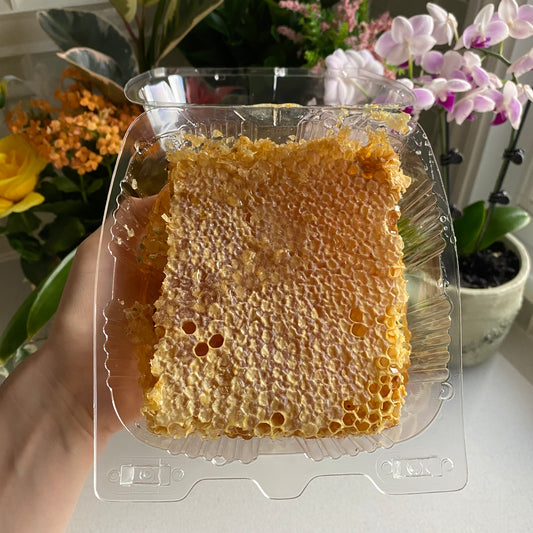
Our raw honeycomb is perhaps the most visually obvious form of unprocessed honey - the structure itself tells you nothing has been done to it since it left the hive.
7. Canadian Honey Grades Explained
This is a section most consumer guides skip entirely, but it is directly relevant to what is in your jar.
Under the Canadian Grade Compendium Volume 6, honey sold in Canada is classified into three grades: Canada No. 1, Canada No. 2, and Canada No. 3. The grade is determined by several factors including moisture content, flavour, aroma, clarity, and absence of defects.
- Canada No. 1 - the highest grade, with moisture content not exceeding 17.8%, good flavour, and minimal defects. This is what you find in quality retail honey.
- Canada No. 2 - slightly higher moisture allowance (up to 20%), may have minor flavour variations or slight fermentation.
- Canada No. 3 - the lowest consumer grade, allowing up to 23% moisture and more significant flavour variations.
Honey also has a colour classification: White, Golden, Amber, and Dark for consumer packaging. Colour reflects the floral source and is not directly related to quality, though darker honeys tend to have higher antioxidant concentrations due to the different pollen and nectar composition of the plants the bees visited.
Note that grade labelling is required for honey that is graded and traded interprovincially or imported. Farm gate honey sold directly from the producer to the consumer at the farm has different labelling requirements. This is actually good news for small local buyers - it often means you are getting the freshest, most traceable product available.
8. What "Natural Honey" Actually Means
Almost nothing, legally speaking.
"Natural" is a loosely defined term in food labelling. The CFIA has guidance on its use, but it does not have a single strict legal definition that prohibits pasteurized or heavily processed honey from being called natural. In most cases, "natural honey" on a label is a marketing phrase, not a meaningful quality claim.
The same applies to terms like "artisanal," "craft," "small-batch," and similar language. These are not regulated terms. They may be accurate, or they may simply be attractive words on packaging. The way to verify any of these claims is to know where your honey comes from and who produced it.
9. Floral Source Labels - What "Wildflower," "Clover," and "Buckwheat" Mean
You will often see honey labelled by its floral source: wildflower, clover, buckwheat, acacia, manuka, and others. These names describe the primary nectar source the bees harvested to produce the honey.
Under Canadian regulations, a honey can be called by a specific floral name if that nectar source predominates - though there is no strict percentage requirement that is publicly enforced for all types. What you can generally rely on:
- Clover honey - light in colour, mild flavour, the most common type in North America
- Wildflower honey - a blend of whatever flowering plants are in bloom near the hive; flavour varies by season and region
- Buckwheat honey - very dark, strong flavour, high antioxidant content compared to lighter honeys
- Manuka honey - from New Zealand, produced from the manuka bush, known for its high methylglyoxal content and associated antimicrobial properties
Our Quebec honey is primarily wildflower - reflecting the diverse flowering plants of the Quebec landscape where our bees forage. This variety in nectar source is part of what gives local artisanal honey a more complex flavour profile than single-source commercial products.
10. Creamed vs Liquid Honey - It Is the Same Honey
Creamed honey (also called whipped or set honey) is not a different product - it is raw honey that has been processed through controlled crystallization to produce a smooth, spreadable texture. A small amount of already-crystallized honey is added to liquid honey as a "seed," and the mixture is held at a cool temperature until it sets uniformly.
The key point: creamed honey can be made from raw, unpasteurized honey and retain all its bioactive properties. Some producers pasteurize before creaming to prevent uncontrolled crystallization, but it is not required. Always check whether creamed honey is also raw if that matters to you.
Read our full breakdown of creamed honey vs liquid honey for a more detailed explanation of the differences in texture, storage, and use.
A Quick Label Checklist Before You Buy
| What to Check | What You Want to See | Red Flag |
|---|---|---|
| Ingredients list | "Honey" and nothing else | Any added sugars or syrups |
| Processing | "Raw" or "unpasteurized" | "Pasteurized" or no mention at all |
| Country of origin | "Product of Canada" or specific province | "Blend of honeys from various countries" |
| Appearance | Cloudy, thick, or partially crystallized | Perfectly clear and liquid |
| Producer info | Name, address, direct contact | Generic distributor with no farm details |
| Grade (if present) | Canada No. 1 | No grade listed on commercial product |
The Honest Version of What Most Store Honey Labels Actually Mean
Most large-brand honey you find in a Canadian grocery store follows a similar path: it is imported in bulk from countries like China, Argentina, or Brazil, pasteurized and ultra-filtered to remove pollen (which also removes the geographic traceability that pollen provides), blended, rebottled, and sold under a Canadian brand name. This is legal. It is not fraudulent in most cases. But it is not what most people imagine when they buy honey.
The terms on the front label - "golden," "natural," "fine," "premium" - are marketing language with no regulatory meaning attached. The only things that carry real meaning on a honey label are: the ingredients list, the country of origin, whether it says raw or unpasteurized, and whether you can trace it back to an actual beekeeper.
Frequently Asked Questions
Does "pure honey" mean it is raw?
No. Pure means no additives. Raw means not heat-treated. These are completely separate claims. A honey can be pure and pasteurized - meaning it contains only honey but has been heated to high temperatures that degrade its enzymes and antioxidants.
Is crystallized honey still good?
Yes - crystallized honey is fully intact and just as potent as liquid honey. Crystallization is a natural process and actually indicates that the honey has not been over-processed. You can read more about this in our guide on how to store raw honey.
How can I tell if honey has been adulterated with sugar syrup?
At home, the most accessible tests are the water test (pure honey sinks and does not dissolve immediately when dropped in cold water, whereas adulterated honey may dissolve quickly) and the crystallization test (pure raw honey will crystallize naturally over weeks or months - adulterated honey often does not crystallize normally or forms unusual textures). See our full guide on how to tell if your honey is real for a step-by-step breakdown.
What is the difference between white, golden, amber, and dark honey?
These are colour classifications under the Canadian Grade Compendium that reflect the floral source and processing history of the honey. They do not directly indicate quality - a dark honey from buckwheat or wildflower is not inferior to a white clover honey, just different in flavour profile and antioxidant composition. Darker honeys tend to have more phenolic compounds.
Is all local honey raw?
Not necessarily, but it is far more likely. Small local beekeepers typically have no commercial reason to pasteurize - they are not producing for a six-month shelf life in national distribution. Always ask your local beekeeper directly how they process their honey. A good producer will have no problem answering.
What should the only ingredient in honey be?
Honey. One ingredient. If there is anything else on that ingredients list, it is not pure honey under Canadian food law.
The Bottom Line
Honey labels are designed by marketing departments. The front of the jar is built to appeal to your intuition about naturalness and quality. The back of the jar is where the truth lives.
Flip every jar. Read the ingredients. Check the origin. Look for "raw" or "unpasteurized." If it is cloudy or crystallized, that is a good sign. If it is crystal-clear and perfect, ask yourself why.
At Miel D'or, our raw Quebec honey is harvested from our own hives in Laval, never pasteurized, minimally filtered, and traceable to the source. You can also explore our full honey product collection or visit our FAQ page for more information on how our honey is produced and what makes it different from what you find in most stores.
Have questions about a specific label claim or product? Contact us directly - we are happy to answer.